1099 vs W2 Taxes: What Freelancers Need to Know (2026 Guide)
- Crystal Harrison
- Mar 15
- 9 min read
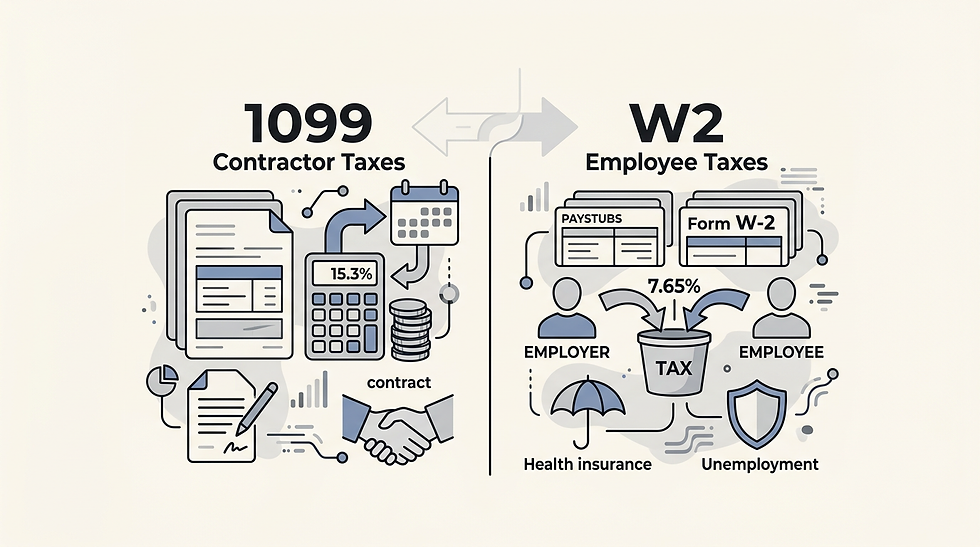
Many people transitioning to freelancing are surprised by the difference between 1099 vs W2 taxes. When you move from W2 employment to 1099 contractor income, taxes work very differently. Employees have taxes withheld automatically, while freelancers must estimate and pay their own taxes throughout the year. Understanding the difference between 1099 and W2 taxes helps freelancers plan for taxes and avoid surprises.
At SnapTax, we've helped thousands of independent contractors navigate this transition. The key is understanding what you're responsible for and planning ahead.
1099 vs W2 taxes: the key difference
The main difference between 1099 vs W2 taxes is who pays the employer portion of Social Security and Medicare taxes. W2 employees split these taxes with their employer, while 1099 contractors must pay the full 15.3% self-employment tax themselves.

Quick answer: What is the difference between 1099 vs W2 taxes?
W2 employees split Social Security and Medicare taxes with their employer, paying 7.65% in FICA taxes while the employer pays the other half. 1099 contractors must pay the full 15.3% self-employment tax, which covers both portions.
Here's the short version:
W2 employees: Pay 7.65% in FICA taxes (employer pays the other 7.65%)
1099 contractors: Pay 15.3% in self-employment tax (covers both employer and employee portions)
That extra 7.65% is why 1099 taxes often feel higher. But deductions can offset this difference significantly.
What is a W2 employee?
A W2 employee is someone who works for a company as a traditional employee on the company's payroll. When you're a W2 employee, your employer handles most of the tax work for you.
Taxes are withheld automatically from every paycheck. Your employer deducts federal income tax, state income tax (if applicable), Social Security tax (6.2%), and Medicare tax (1.45%) before you ever see the money. They send these taxes directly to the IRS and state tax authorities on your behalf.
Your employer pays half of FICA taxes. FICA (Federal Insurance Contributions Act) covers Social Security and Medicare. For W2 employees, the employer pays 7.65% and the employee pays 7.65%. You only see the employee portion coming out of your check.
At the end of the year, you receive a Form W-2 that shows your total wages and how much was withheld for taxes. You use this form to file your tax return.
Common examples of W2 employees include office workers, retail employees, healthcare staff, and factory workers. These workers typically receive benefits like health insurance, retirement plans (401k), and paid time off as part of their compensation package.
What is a 1099 contractor?
A 1099 contractor (also called an independent contractor or freelancer) is self-employed. Instead of working as an employee, you run your own business and provide services to clients.
Your income is reported as self-employment income on Form 1099-NEC. Clients must send you this form if they paid you $600 or more during the year. Unlike a W-2, the 1099-NEC shows your gross payments with no taxes withheld.
As a freelancer, you're responsible for calculating, saving, and paying all your taxes. There's no employer to withhold taxes or pay half your FICA. This means you need to set aside money from every payment you receive to cover your tax bill.
Common 1099 contractors include freelance writers, graphic designers, consultants, gig workers like delivery drivers, and sole proprietors like handymen or tutors. These workers don't receive employee benefits and must arrange their own health insurance, retirement savings, and paid time off.
Why 1099 taxes feel higher
The biggest shock for new freelancers is the self-employment tax. Here's how it works.
The self-employment tax explained
Self-employment tax is 15.3% of your net earnings from self-employment. It breaks down like this:
Social Security: 12.4% (applies to first $184,500 of net earnings for 2026)
Medicare: 2.9% (applies to all net earnings, no limit)
You calculate this on 92.35% of your net business income (the IRS gives you this small break because employers can deduct their portion).
Income Type | Social Security & Medicare | Who Pays |
W2 Employee | 7.65% | Employee |
W2 Employer | 7.65% | Employer |
1099 Contractor | 15.3% | Freelancer |
Do 1099 workers pay more taxes than W2 employees?
Many freelancers assume they pay more taxes simply because they see the full 15.3% self-employment tax. However, freelancers also have access to deductions that employees cannot claim, including business expenses, home office deductions, and retirement contributions. Because of these deductions, the actual tax difference between 1099 vs W2 income can be smaller than expected.
Why freelancers pay both sides
When you're a W2 employee, your employer pays half your Social Security and Medicare taxes. When you're a 1099 contractor, there's no employer. You are the employer and the employee, so you pay both portions.

The math: A real example
Let's look at someone earning $80,000 per year:
W2 employee on $80k:
Pays 7.65% in FICA taxes = $6,120
Employer pays the other $6,120
1099 contractor on $80k:
Pays 15.3% self-employment tax on 92.35% of $80,000 = $11,304
Difference: The 1099 worker pays about $5,184 more
That's a significant difference. But remember, this is just the self-employment tax portion. Both workers also pay federal and state income taxes based on the same tax brackets.
The good news: You can deduct 50% of your self-employment tax on your Form 1040, which reduces your taxable income.
How freelancers reduce their 1099 vs W2 tax difference
The 1099 vs W2 tax difference isn't as bad as it first appears because freelancers have access to deductions that W2 employees don't.
Business expense deductions
As a 1099 contractor, you can deduct ordinary and necessary business expenses from your taxable income. Common deductions include:
Home office expenses (if you use a dedicated space exclusively for work)
Business mileage (72.5 cents per mile for 2026)
Equipment and software
Professional development and training
Business insurance
Professional memberships
These deductions reduce your net income, which reduces both your income tax and your self-employment tax.
Health insurance deduction
Self-employed workers can deduct 100% of their health insurance premiums (for themselves and their families) as an adjustment to income. This is an "above-the-line" deduction, meaning you don't need to itemize to claim it.
Retirement contributions
1099 contractors can contribute to retirement accounts with higher limits than traditional employees:
SEP-IRA: Contribute up to 25% of net earnings (max $69,000 for 2026)
Solo 401(k): Contribute as both employer and employee (max $76,500 for 2026 if age 50+)
These contributions reduce your taxable income immediately.
Qualified Business Income (QBI) deduction
Many freelancers qualify for the QBI deduction, which lets you deduct up to 20% of your qualified business income. This deduction was introduced in 2018 and was made permanent in 2025 with the One Big Beautiful Bill Act (OBBBA).
The strategy: Track every expense
The key to reducing your tax burden is tracking every business expense throughout the year. Many freelancers overpay taxes simply because they don't keep good records. For more guidance on what you can deduct, check out our article on how much freelancers should save for taxes.
To see which expenses you can deduct, read our full guide to freelancer tax deductions.
Why freelancers must pay quarterly taxes
When you're a W2 employee, taxes are withheld from every paycheck. When you're a 1099 contractor, no one withholds taxes for you. This creates a problem: the IRS wants its money throughout the year, not just in April.
Estimated tax payments required
If you expect to owe $1,000 or more in taxes for the year, you must make quarterly estimated tax payments. This includes both income tax and self-employment tax.
2026 quarterly due dates
Mark these dates on your calendar:
Q1: April 15, 2026
Q2: June 15, 2026
Q3: September 15, 2026
Q4: January 15, 2027
Consequences of missing payments
If you don't pay enough tax throughout the year, you may face underpayment penalties and interest charges when you file your return. The penalty is essentially interest on the amount you should have paid earlier.
Safe harbor rule
You can avoid penalties by paying at least:
100% of your prior year tax liability, or
110% of your prior year tax liability if your adjusted gross income was over $150,000
This is called the "safe harbor" rule. Even if you earn more this year, you won't be penalized if you meet these thresholds.
The challenge: Irregular income
Freelancers often have irregular income, which makes estimating taxes difficult. You might have a great month followed by a slow one. This is why many freelancers use a percentage-based approach, setting aside 25-30% of every payment they receive.

How to calculate your 1099 tax estimate
Calculating your estimated taxes doesn't have to be complicated. Here's a simple approach.
The formula
Your estimated tax = (Net income × 15.3% self-employment tax) + (Net income × income tax rate) - Deductions
Let's break it down:
1. Calculate your net business income (revenue minus expenses)
2. Calculate self-employment tax (15.3% of 92.35% of net income)
3. Estimate your income tax based on your tax bracket
4. Subtract deductions (QBI, self-employment tax deduction, etc.)
5. Divide by 4 for your quarterly payment amount
Rule of thumb: Save 25-30%
If you want a simpler approach, save 25-30% of every payment you receive for taxes. This covers both self-employment tax and income tax for most freelancers.
For example, if you receive a $2,000 payment, immediately transfer $500-$600 to a separate savings account for taxes. This prevents the "I spent my tax money" problem that hits many new freelancers.
Use a 1099 tax calculator for a better estimate
Estimating freelance taxes manually can be confusing because both income tax and self-employment tax apply. A 1099 tax calculator helps you estimate how much you’ll owe based on your income, deductions, and filing status. Use our 1099 tax calculator to quickly estimate your freelance tax liability.
It factors in your specific income, deductions, and filing status to give you an accurate estimate of what you'll owe.
How SnapTax simplifies 1099 tax tracking
Managing taxes as a freelancer doesn't have to be stressful. SnapTax was built specifically for 1099 contractors who want clarity without becoming accountants.
Track income monthly
Enter your income and expenses into SnapTax monthly and choose how you want to estimate your future income and expense and SnapTax will automatically calculate your 1099 tax liability and payments. No more manual spreadsheets or guessing how much you owe.
See real-time tax estimates
Your tax estimate updates automatically as your income changes. You'll always know exactly how much to save and how much your quarterly payments should be.
Never miss a quarterly deadline
SnapTax sends you reminders before each quarterly tax due date, so you never miss a payment or face penalties.
No accounting jargon
We built SnapTax for freelancers, not accountants. You don't need to understand debits, credits, or chart of accounts. Just enter your net income and get clear answers about what you owe.
1099 vs W2 taxes: Which is better for freelancers?
So which is better from a tax perspective? It depends on your situation.
W2 advantages:
Simplicity: Taxes are handled for you
Predictable withholding: You know exactly what you're getting each paycheck
Employer-paid FICA: Your employer covers half your Social Security and Medicare taxes
1099 advantages:
Deduction opportunities: More ways to reduce taxable income
Flexibility: Control over how you structure your business
QBI deduction: Potential 20% deduction on qualified business income
Retirement contribution limits: Higher contribution limits than employees
The reality: 1099 workers often pay more in taxes unless they maximize their deductions. The self-employment tax burden is real, but smart tax planning can offset much of it.
Bottom line: If you value simplicity and don't want to think about taxes, W2 is probably better. If you're willing to track expenses and make quarterly payments, 1099 can work out favorably, especially with good deductions.
If you want a better estimate of what you’ll owe as a freelancer, try our 1099 tax calculator or read our guide on how much freelancers should save for taxes.
By Crystal Harrison
Founder SnapTax and Former Professional Bookkeeper
Disclaimer: The information provided on this site is for educational purposes only and does not constitute tax, legal, or financial advice. Consult a qualified tax professional for advice specific to your situation.
Frequently Asked Questions
Do 1099 workers pay more taxes than W2 employees?
Generally yes, because 1099 workers pay the full 15.3% self-employment tax while W2 employees only pay 7.65% (with their employer covering the other half). However, 1099 workers can deduct business expenses that W2 employees cannot, which can offset some or all of this difference.
How much should I save for taxes as a 1099 contractor?
A good rule of thumb is to save 20-30% of every payment you receive. This covers both self-employment tax and federal income tax. If you're in a high tax bracket or have significant state taxes, you may need to save more.
Can I deduct health insurance as a 1099 worker?
Yes. Self-employed workers can deduct 100% of their health insurance premiums for themselves and their families as an adjustment to income. This is one of the most valuable deductions available to 1099 contractors.
What happens if I don't pay quarterly taxes as a 1099 contractor?
If you don't pay enough tax throughout the year, you may face underpayment penalties and interest charges when you file your return. You can avoid penalties by paying at least 100% of your prior year tax liability (110% if your AGI was over $150,000).
Is it better to be a 1099 or W2 for tax purposes?
It depends on your situation. W2 employment offers simplicity and employer-paid FICA taxes. 1099 work offers more deduction opportunities and flexibility but requires more tax management. If you have significant business expenses and are disciplined about tracking them, 1099 can be favorable.
What is the self-employment tax rate for 2026?
The self-employment tax rate remains 15.3% for 2026. This consists of 12.4% for Social Security (on earnings up to $184,500) and 2.9% for Medicare (no earnings limit). You calculate this on 92.35% of your net business income.


Comments