Maximize Your Freelance Tax Deductions in 2026: A Practical Guide
- Crystal Harrison
- Mar 18
- 12 min read

Freelance tax deductions explained (in plain English)
Freelance tax deductions can significantly reduce how much you owe each year, but many freelancers miss them simply because they don’t know what qualifies. If you’re self-employed, understanding which expenses you can deduct is one of the most important ways to keep more of what you earn. You started your business to do work you're good at, set your own schedule, and build something for yourself. But then April rolls around, and suddenly you're drowning in forms, wondering if that coffee you bought during a client call counts as a business expense.
What are freelance tax deductions?
Freelance tax deductions are business expenses that self-employed workers can subtract from their income before calculating taxes. Common freelance tax deductions include home office expenses, business mileage, software subscriptions, professional services, and health insurance premiums.

Here's the truth: tax deductions aren't loopholes. They're not tricks or gray areas. Deductions are legitimate business expenses that the IRS fully expects you to claim. When you skip them, you're literally paying taxes on money you never actually keep.
Think about it this way: if you earned $60,000 but spent $15,000 on legitimate business expenses, you only made $45,000. Without deductions, you'd pay taxes on the full $60,000. That's like paying for groceries you never bought.
Income | Business Expenses | Taxable Income |
$60,000 | $0 | $60,000 |
$60,000 | $15,000 | $45,000 |
Freelance tax deductions reduce the amount of income you’re taxed on. The lower your taxable income, the less you owe in both income tax and self-employment tax.
The good news? You don't need an accounting degree to get this right. This guide breaks down the top freelance tax deductions for 2026 in plain English. No jargon, no judgment, just practical information you can use to keep more of what you earn. And if you want a simple way to track everything year-round, use our 1099 tax calculator to estimate how much you owe based on your income and deductions. start your free 7-day trial with SnapTax and see how much easier tax season can be.
Common freelance tax deductions you might be missing
The IRS uses two words to determine if something is deductible: "ordinary" and "necessary." In normal language, that means:
Ordinary: Something common in your line of work. A photographer buying camera equipment is ordinary. A photographer buying a surfboard (unless they shoot surf photography) is not.
Necessary: Something helpful and appropriate for your business. It doesn't have to be indispensable, just reasonable.
Here's a common misconception: you don't need an LLC or a fancy business structure to deduct expenses. If you receive a 1099-NEC or 1099-K, the IRS considers you self-employed. That means you can deduct business expenses even if you're just doing gig work on the side.
The golden rule is simple: keep business and personal expenses separate. Get a dedicated business credit card or bank account. When you mix them, you create a record-keeping nightmare and raise red flags if you're ever audited.
Still have questions about what counts? Check out our tax FAQ for answers to the most common questions we hear from freelancers.
Home office and workspace deductions
If you work from home, you might be leaving money on the table. The home office deduction lets you write off a portion of your housing costs, but many freelancers skip it because they think it's complicated or might trigger an audit. Here's the reality: it's straightforward if you follow the rules.

The simplified method
The easiest approach is the simplified method. You get $5 per square foot of your home office, up to 300 square feet. That means a maximum deduction of $1,500 per year.
The math is simple: if your home office is 120 square feet, your deduction is $600 (120 x $5). No receipts to track, no percentage calculations, just measure your space and you're done.
The actual expense method
If you have a larger space or high housing costs, the actual expense method might save you more. Here's how it works:
Calculate what percentage of your home is used exclusively for business. If your home office is 200 square feet and your home is 2,000 square feet, that's 10%. You can then deduct 10% of your rent or mortgage interest, utilities, insurance, and repairs.
Let's say your annual housing costs are $24,000. Ten percent of that is $2,400, which beats the simplified method's $1,000 maximum for a 200-square-foot office.
What counts as a home office
To qualify, your workspace must meet three requirements:
It must be a clearly defined space (a separate room or a portion of a room with clear boundaries)
It must be used regularly and exclusively for business (no doubling as a guest bedroom)
It must be your principal place of business
The "exclusive use" rule trips people up. Working from your kitchen table doesn't count because you also eat there. But a corner of your living room with a dedicated desk that you only use for work? That can qualify if it's clearly defined and used exclusively for business.
Vehicle and travel deductions
Driving for your business adds up quickly. Client meetings, supply runs, conferences, even trips to the post office to mail contracts, these miles are all deductible.
Standard mileage rate for 2026
For 2026, the IRS standard mileage rate is 72.5 cents per mile, up from 70 cents in 2025. That 2.5-cent increase might not sound like much, but it adds up. Drive 10,000 business miles this year and that's a $7,250 deduction.

The standard mileage rate covers everything: gas, insurance, maintenance, depreciation, and registration. You just need to track your business miles. Apps like MileIQ can automate this by logging trips automatically. You just swipe to categorize them as business or personal. You can also use our 1099 tax calculator to see how mileage deductions impact your estimated tax bill.
Actual expense method
If you have a newer vehicle or high operating costs, the actual expense method might work better. You track everything you spend on your vehicle (gas, oil changes, repairs, insurance, depreciation) and deduct the business percentage.
The catch? You have to track your business vs. personal use percentage. If you drive 12,000 miles total and 8,000 were for business, that's 67% business use. You can deduct 67% of your actual vehicle expenses.
Once you choose a method for a vehicle, you're generally stuck with it. You can't switch from actual expenses to standard mileage later, so choose carefully in your first year.
Business travel
Traveling for work? Those expenses add up fast, and most are fully deductible. Here's what counts:
100% deductible: Airfare, hotels, rental cars, taxis, parking, tolls
50% deductible: Business meals while traveling
Not deductible: Personal entertainment, sightseeing, family travel expenses
To qualify as business travel, your trip must require you to sleep away from home and be primarily for business purposes. Keep records of why you traveled, who you met with, and what business purpose was served.
Health and retirement deductions (the big ones)
These two deductions can save you thousands, yet many freelancers miss them entirely.
Health insurance premiums
If you pay for your own health insurance, you can deduct 100% of your premiums for yourself, your spouse, and your dependents. This is an "above-the-line" deduction, which means you can take it even if you don't itemize. It reduces your Adjusted Gross Income (AGI) for income taxation which only applies for federal income tax and not self-employed taxes.
There's one catch: you can't claim this deduction for any month you were eligible to participate in an employer-sponsored health plan, including through your spouse's job. If your spouse has employer coverage and you chose not to join it, you can't deduct your individual premiums.
This deduction goes on Schedule 1, not Schedule C, so it's separate from your business expenses.
Retirement contributions
Contributing to a retirement account reduces your taxable income now and builds wealth for later. For freelancers, two options stand out:

SEP-IRA: You can contribute up to $72,000 for 2026 (up from $70,000 in 2025) or 25% of your net self-employment earnings, whichever is less. SEP-IRAs are easy to set up and have no annual filing requirements.
Solo 401(k): Also called an individual 401(k), this option has even higher limits. You can contribute as both the employee and the employer. The employee portion allows up to $24,000 for 2026 (plus a $8,000 catch-up if you're 50+), and the employer portion allows up to 25% of compensation. Total contributions can't exceed $70,000 (or $80,000 if 50+).
The best part? Retirement contributions reduce both your income tax AND your self-employment tax. It's one of the most powerful deductions available. Use our 1099 tax calculator to see exactly how much you could save.
Common freelance tax deductions many people miss
Beyond the big deductions, dozens of smaller expenses add up throughout the year. Here are the ones freelancers commonly overlook.
Professional services
Hiring help is deductible. This includes:
Accountants and bookkeepers (yes, tax prep fees are deductible)
Lawyers for contract review or business matters
Business consultants and coaches
Virtual assistants
If someone helps you run your business, their fees are likely deductible.
Education and training
Investing in your skills is deductible if the training maintains or improves your current work. This includes:
Online courses and webinars related to your field
Professional conferences and workshops
Business books and industry publications
Professional memberships and association dues
The key word is "current." Training for a new career isn't deductible. If you're a web designer taking a course on advanced CSS, that's deductible. If you're taking courses to become a veterinarian, that's not.
Technology and software
Your laptop, phone, and software subscriptions are all deductible. For expensive equipment (computers, cameras, printers), you typically depreciate the cost over several years or take a Section 179 deduction to write it off immediately.
Software subscriptions are fully deductible in the year you pay for them. This includes your accounting software, design tools, project management apps, and yes, even your Spotify if you use it while working (though that's a gray area some accountants avoid).
For shared items like your phone and internet, deduct the business percentage. If you use your phone 60% for business, deduct 60% of the bill.
Marketing and advertising
Getting the word out about your business is 100% deductible. This includes:
Website design and hosting
Business cards and brochures
Online advertising (Google Ads, Facebook, LinkedIn)
Photography and branding
Promotional materials and swag
Even sponsorships of local events or newsletters can qualify if they're genuinely for business promotion.
Business insurance
Protecting your business is deductible too. Premiums for general liability, professional liability (errors and omissions), cyber liability, and business interruption insurance are all fully deductible.
The 20% Qualified Business Income deduction
This one's a big deal. The Qualified Business Income (QBI) deduction lets you deduct up to 20% of your net business income automatically. No receipts to track, no forms to fill out beyond Form 8995.
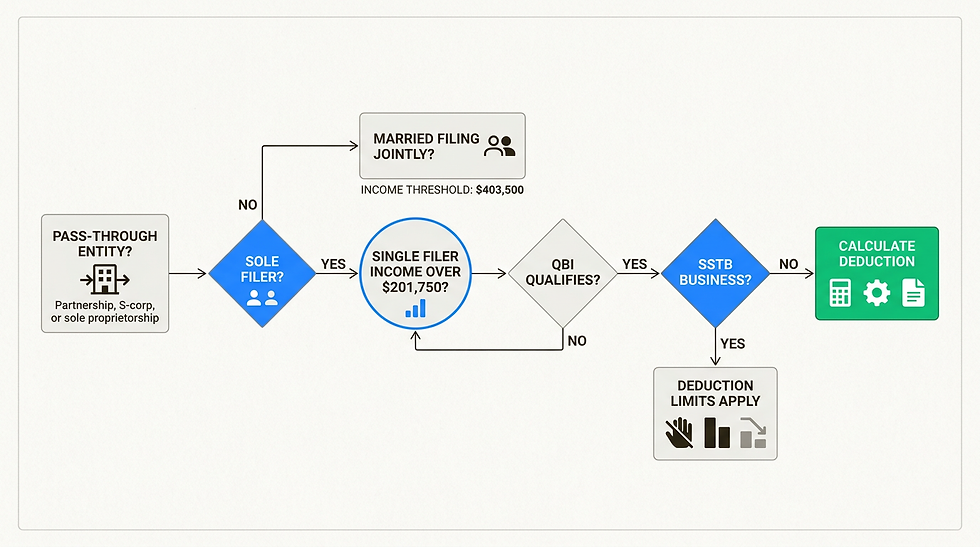
To qualify, your business must be a "pass-through" entity. Sole proprietors, LLCs, partnerships, and S corporations all qualify. C corporations do not.
Income limits apply. For 2026, the deduction begins to phase out at:
$201,750 for single filers
$403,500 for married couples filing jointly
If your income is below these thresholds, you generally qualify for the full 20% deduction. Above them, things get more complicated depending on your business type.
This deduction is taken on your personal return, not your business return. It reduces your taxable income but not your self-employment tax, so you still pay full Social Security and Medicare taxes on your business income.
This example shows how freelance tax deductions reduce taxable income and lower both income tax and self-employment tax.
Common mistakes that cost freelancers money
Even well-meaning freelancers make these errors. Avoid them and you'll keep more of your money.

Mixing personal and business expenses. Get a separate business credit card and bank account. Commingling funds creates a record-keeping mess and makes you look less legitimate to the IRS.
Not tracking mileage in real time. Trying to reconstruct mileage logs in April is nearly impossible. Use an app to track trips as they happen. The IRS requires contemporaneous records, meaning you can't just guess later.
Skipping the home office deduction. Many freelancers avoid this because they fear it triggers audits. The reality? If you qualify and keep good records, it's a legitimate deduction. Don't leave money on the table out of fear.
Forgetting quarterly taxes is one of the most common mistakes freelancers make. See our guide to quarterly tax deadlines for freelancers to stay on track and avoid penalties. If you expect to owe $1,000 or more in taxes for the year, you need to make quarterly estimated payments. Missing them means penalties and interest. Check our quarterly tax deadlines page to stay on track.
Not claiming deductions because you don't have an "official" business. If you get a 1099, you're in business. You don't need an LLC, business cards, or a website to deduct legitimate expenses.
Waiting until April to think about deductions. By then, it's too late to maximize your deductions. You need to track expenses year-round to capture everything.
How to track deductions without the headache
The shoebox full of receipts doesn't work. Neither does the "I'll remember it later" approach. Here's a simple system that actually works.
Capture receipts immediately. Snap a photo with your phone the moment you get a receipt. Apps like SnapTax, Expensify, or even just a dedicated folder in your photos can work. The key is doing it immediately, not "when you get home."
Categorize monthly. Set a recurring calendar reminder to categorize expenses. It takes 15 minutes once a month versus hours in April. Categorize by deduction type: office supplies, travel, meals, professional services, etc.
Keep records for three years. The IRS generally has three years to audit your return, so keep supporting documents for at least that long. If you underreported income by 25% or more, they can go back six years. When in doubt, keep it seven years.
What records to keep:
Receipts for all business expenses
Bank and credit card statements
Mileage logs
Invoices from clients and contractors
1099s received
Quarterly tax payment confirmations
Want a more detailed guide to staying organized? Download our free guide with templates and checklists for freelancers.
Start keeping more of what you earn today
Tax deductions aren't complicated. They're simply business expenses that reduce your taxable income. The IRS knows it costs money to run a business, and they've built the tax code to account for that.
The key is tracking expenses year-round, not scrambling in April. Separate your business and personal finances. Keep records organized. And don't be afraid to claim legitimate deductions, you've earned them.
You weren't meant to become an accountant. You started your business to do work you care about. Let SnapTax handle the number crunching while you focus on what you do best.
Our platform tracks your income, categorizes expenses, estimates quarterly taxes, and shows you exactly what you owe in real time. No spreadsheets, no guesswork, no April surprises.
Ready to make tax season simple? Start with our 1099 tax calculator or begin your free trial to track your income and deductions in real time. Start your free 7-day trial today and see how much easier freelancing can be when your taxes are under control.
By Crystal Harrison
Founder SnapTax and Former Professional Bookkeeper
Disclaimer: The information provided on this site is for educational purposes only and does not constitute tax, legal, or financial advice. Consult a qualified tax professional for advice specific to your situation.
Frequently Asked Questions
Do I need an LLC to claim freelance tax deductions in 2026?
No. You can deduct business expenses as a sole proprietor without any formal business structure. If you receive a 1099-NEC or 1099-K, you can claim deductions on Schedule C of your personal tax return.
What are the most common freelance tax deductions?
Common freelance tax deductions include home office expenses, mileage, software subscriptions, marketing costs, professional services, health insurance premiums, and retirement contributions. These deductions reduce your taxable income and lower your overall tax bill.
What is the standard mileage rate for freelance tax deductions in 2026?
The IRS standard mileage rate for business use in 2026 is 72.5 cents per mile, up from 70 cents in 2025. This rate covers gas, insurance, maintenance, and depreciation.
How much can I contribute to a SEP-IRA for freelance tax deductions in 2026?
For 2026, you can contribute up to $72,000 or 25% of your net self-employment earnings, whichever is less. This is up from $70,000 in 2025.
Can I deduct my home office as a freelance tax deduction in 2026?
Yes, if you use a portion of your home exclusively and regularly for business. You can use the simplified method ($5 per square foot up to 300 square feet) or the actual expense method (percentage of housing costs).
What percentage of business meals can I deduct as a freelance tax deduction in 2026?
Business meals are 50% deductible in 2026. The meal must be ordinary and necessary for your business, and you or your employee must be present.
Do I need to make quarterly tax payments to maximize freelance tax deductions in 2026?
Quarterly payments don't affect your deductions, but they help you avoid penalties. If you expect to owe $1,000 or more in taxes for the year, you generally need to make quarterly estimated payments.
What is the Qualified Business Income deduction for freelance tax deductions in 2026?
The QBI deduction allows eligible freelancers to deduct up to 20% of their qualified business income. For 2026, it begins to phase out at $201,750 for single filers and $403,500 for married couples filing jointly.


Comments