Home Office Deduction for Freelancers (2026): Rules, Examples, and Tax Savings
- Crystal Harrison
- Mar 19
- 12 min read

Many freelancers work from home, but not everyone realizes they may qualify for the home office deduction for freelancers, one of the most valuable tax write-offs available. This deduction can reduce your taxable income by allowing you to write off a portion of your housing expenses used for business. According to IRS data, small business owners and freelancers leave thousands of dollars in deductions unclaimed each year—home office expenses are one of the most commonly missed categories.
However, the rules around the home office deduction can be confusing. The IRS requires the space to be used regularly and exclusively for business, and there are two different methods for calculating the deduction.
Understanding these rules can help freelancers avoid mistakes and make sure they claim the full deduction they're entitled to. Let's break it down.
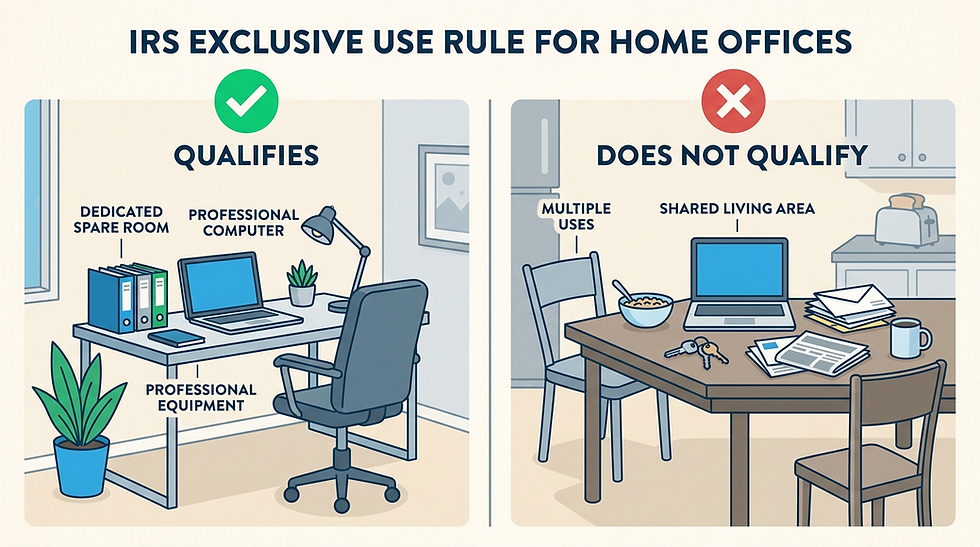
Table of Contents
Who qualifies for the home office deduction for freelancers
IRS rules: regular and exclusive use
Two ways to calculate the home office deduction
Real example: Home office deduction for a freelancer
What expenses can be included in your home office deduction
Common home office deduction mistakes to avoid
Simplified vs regular method
How the home office deduction affects your taxes
FAQs
Who qualifies for the home office deduction for freelancers
To claim the home office deduction, you must meet three IRS requirements. Let's look at each one.
Regular use
You must use the space on a continuous, ongoing, or recurring basis. Occasional or incidental use doesn't qualify. If you only work from home a few days per month, you likely won't meet this test.
Exclusive use
This is the requirement that trips up most freelancers. The space must be used only for business. No personal use allowed.
What qualifies:
A dedicated office room used solely for work
A separate workspace (even a section of a room) used exclusively for business
A separate structure like a garage, studio, or shed used only for business
What does NOT qualify:
Kitchen table where you also eat meals
Couch workspace in the living room where family watches TV
Bedroom office that doubles as a guest room
Any shared personal/business space
The exclusive use rule is strict. If your kids use the computer for homework or your spouse occasionally checks email on your work laptop, you technically don't qualify.
Principal place of business
Your home office must be where you conduct administrative or management activities for your business. This includes:
Billing customers and clients
Keeping books and records
Ordering supplies
Setting up appointments
Writing reports
Even if you meet clients elsewhere or perform services at other locations, you can still qualify if your home is where you handle the business side of things.
Important exceptions to the exclusive use rule:
Daycare facilities: If you use part of your home as a licensed daycare, you don't need to meet the exclusive use test
Inventory storage: If you store product samples or inventory in your home and it's your only fixed business location, exclusive use isn't required
Who cannot claim the deduction: W-2 employees who work from home. Since the 2018 Tax Cuts and Jobs Act, only self-employed individuals can claim the home office deduction. If you receive a W-2, even if you work remotely full-time, you don't qualify. However, you can ask your employer about reimbursement through an accountable plan, which is typically tax-free.
If you're not sure whether you qualify as self-employed, check out our W2 vs 1099 guide to see how your income is classified.
---
Two ways to calculate the home office deduction
The IRS gives you two methods for calculating your deduction. You can choose whichever gives you the larger write-off.
Understanding freelance home office tax deductions helps you choose the method that maximizes your savings
Simplified method
The simplified method lives up to its name. Here's how it works:
Multiply your office square footage by $5
Maximum area: 300 square feet
Maximum deduction: $1,500
Example: If your home office is 200 square feet, your deduction is $1,000 (200 × $5).
Pros:
Simple calculation
Minimal recordkeeping required
No depreciation to calculate
No depreciation recapture when you sell your home
Home-related itemized deductions (mortgage interest, property taxes) claimed in full on Schedule A
Cons:
Smaller deduction possible
No depreciation benefit
No carryover of unused deductions
Regular method (actual expenses)
The regular method requires more work but often results in a larger deduction, especially if you have high housing costs or a larger office space.
Step 1: Calculate your business use percentage
Measure your home office square footage
Measure your total home square footage
Divide office area by total area
Step 2: Apply the percentage to indirect expenses
Indirect expenses (partially deductible):
Rent or mortgage interest
Property taxes
Utilities (electric, gas, water)
Homeowners or renters insurance
Internet service
General repairs and maintenance
Step 3: Add 100% of direct expenses
Direct expenses (fully deductible):
Office-specific repairs
Office painting
Office furniture and equipment
Office lighting fixtures
Office flooring
Example calculation:
Home office: 150 square feet
Total home: 1,200 square feet
Business use percentage: 12.5%
Annual rent: $24,000
Annual utilities: $3,600
Annual internet: $1,200
Deductible portion: 12.5% of $28,800 = $3,600
In this example, the regular method gives you a $3,600 deduction compared to just $750 using the simplified method (150 sq ft × $5).

Important: The regular method requires filing Form 8829 with your tax return. The simplified method doesn't require this form; you simply enter the deduction directly on Schedule C.
For help planning how deductions affect your quarterly payments, see our guide on quarterly tax deadlines.
---
Real example: Home office deduction for a freelancer
Let's walk through a realistic scenario to see how this works in practice.
Meet Sarah, a freelance graphic designer:
Annual freelance income: $80,000
Home office: 150 square feet (dedicated bedroom converted to office)
Total home: 1,200 square feet
Business use percentage: 12.5%
Sarah's annual housing expenses:
Rent: $24,000
Utilities (electric, gas, water): $3,600
Internet: $1,200
Renters insurance: $600
Office furniture and equipment: $800 (direct expense)
Total housing expenses: $29,400
Regular method calculation:
Indirect expenses: 12.5% of $28,600 = $3,575
Direct expenses: $800 (100% deductible)
Total deduction: $4,375
Simplified method comparison:
150 sq ft × $5 = $750
Total deduction: $750
The difference: The regular method gives Sarah $3,625 more in deductions.
Tax impact:
Sarah's taxable income drops from $80,000 to $75,625
Federal income tax savings (22% bracket): approximately $798
Self-employment tax savings (15.3%): approximately $554
Total estimated tax savings: approximately $1,352
Bottom line? Taking the time to calculate using the regular method pays off significantly for Sarah.
---
What expenses can be included in your home office deduction
Understanding which expenses qualify helps you maximize your deduction while staying compliant.
Direct expenses (100% deductible)
These are costs that benefit only your home office:
Office repairs and maintenance (fixing a broken office window)
Office painting (painting the office walls)
Office furniture (desk, chair, shelving, filing cabinets)
Office equipment (computer, printer, scanner, monitor)
Office lighting fixtures
Office flooring (carpet or flooring installed in the office)
Keep receipts for all direct expenses. These are fully deductible regardless of your business use percentage.
Indirect expenses (percentage-based)
These are costs for your entire home. You deduct the business use percentage, and they are considered deductible home office expenses:
Rent or mortgage interest: Your monthly rent or the interest portion of mortgage payments
Property taxes: Real estate taxes paid on your home
Utilities: Electric, gas, water, trash collection
Insurance: Homeowners or renters insurance premiums
Internet and phone: Business portion of connectivity costs
General repairs: Roof repairs, HVAC maintenance, plumbing fixes
Security system: Monthly monitoring fees
Cleaning service: If you use a cleaning service for your entire home
Expenses you cannot deduct:
Landscaping and lawn care (unless you're in a lawn care business)
Painting rooms not used for business
Home improvements that add value (these are capital improvements, not repairs)
Personal expenses unrelated to business
For a complete list of deductions available to freelancers, check out our full guide to freelancer tax deductions
---
Common home office deduction mistakes to avoid
Many freelancers miss out on legitimate home office tax write-offs due to simple documentation errors.
The IRS looks closely at home office deductions because they're frequently claimed incorrectly. Here are the most common mistakes that trigger scrutiny or reduce your legitimate deduction.
Claiming shared spaces
The biggest mistake freelancers make is trying to deduct a space that isn't exclusively for business. Your kitchen table, living room couch, or dining room don't qualify, even if that's where you usually work.
Solution: Create a truly exclusive workspace, even if it's just a desk in a corner of a room that you section off for business use only.
Estimating square footage incorrectly
Guessing your office dimensions or eyeballing the space can lead to errors. The IRS may ask how you calculated your business use percentage.
Solution: Use a tape measure to get exact dimensions. Document your calculations and keep them with your tax records.
Not tracking expenses throughout the year
Scrambling to find receipts at tax time means you'll miss deductible expenses. Many freelancers underestimate their actual costs.
Solution: Set up a simple system to record expenses monthly. Keep digital copies of receipts in a dedicated folder.
Mixing personal and business usage
If family members use your office computer for personal tasks or your kids do homework at your desk, you technically don't meet the exclusive use requirement.
Solution: Maintain strict separation. If you have a family computer, keep your work computer separate and off-limits for personal use.
W-2 employees claiming the deduction
Remote employees sometimes assume they can claim the home office deduction. Since the 2018 tax reform, only self-employed individuals qualify.
Solution: If you're a W-2 employee working from home, ask your employer about reimbursement through an accountable plan instead.
Poor documentation
The IRS can audit your return years after you file. Without proper records, you may have to repay deductions with penalties and interest.
Solution: Keep all receipts, bills, and documentation for at least three years after filing. Take photos of your office space showing its exclusive business use.
For more tax tips and common questions, visit our Tax FAQ page.
---
When to use simplified vs. regular method
Choosing the right method can mean the difference between a $750 deduction and a $4,000+ deduction. Here's how to decide.

Simplified method works best if:
You have a small office space (under 200 square feet)
Your housing expenses are relatively low
You want simple recordkeeping
You rent in a low-cost area
Your business use is short-term or temporary
You want to avoid depreciation recapture concerns when selling your home
Regular method works best if:
You have a larger office space (200+ square feet)
Your housing expenses are high (expensive rent or mortgage, high utilities)
You keep detailed records anyway
You own your home and want the depreciation benefit
You plan to use the home office long-term
You want to maximize your deduction
Pro tip: Calculate both methods every year and choose whichever gives you the larger deduction. You can switch methods from year to year without penalty. If you use the simplified method one year, you can use the regular method the next, and vice versa.
---
How the home office deduction affects your taxes
The home office deduction for freelancers reduces both income tax and self-employment tax, making it one of the most powerful deductions available.
Understanding the tax impact helps you appreciate why this deduction matters so much for freelancers.
The home office deduction reduces your taxable business income, which lowers both your federal income tax and your self-employment tax. This double benefit makes it particularly valuable.
How the math works:
Let's say you have a $3,000 home office deduction and you're in the 22% federal tax bracket:
Income tax savings: $3,000 × 22% = $660
Self-employment tax savings: $3,000 × 15.3% = $459
Total tax savings: approximately $1,119
About self-employment tax:
Self-employment tax is 15.3% of your net earnings, covering both the employer and employee portions of Social Security and Medicare taxes. It breaks down as:
12.4% for Social Security
2.9% for Medicare
The home office deduction reduces your net earnings, which directly lowers this tax.
Important limitations:
Your home office deduction cannot exceed your business gross income
If using the regular method, you can carry over unused deductions to future years
The simplified method has no carryover provision
The deduction affects your quarterly estimated tax payments
For more on how much to set aside for taxes, read our guide on how much freelancers should save for taxes. You can also learn more about the self-employment tax rate and how it affects your bottom line.
---
How SnapTax helps freelancers track home office deductions
Tracking home office expenses throughout the year can be difficult without a system. Receipts get lost, calculations get complicated, and tax time becomes stressful.
Here's the problem many freelancers face: you pay rent and utilities every month, but you don't think about the tax implications until April. By then, you've forgotten about that office chair you bought in March or the paint job you did in July.
How we help:
At SnapTax, we built our platform specifically for freelancers and independent contractors who need to stay on top of their taxes year-round.
Track income and expenses as they happen: Record deductible home office expenses when you pay them, not months later
See tax estimates update automatically: Watch your estimated tax liability change in real-time as you add deductions
Plan quarterly tax payments: Know exactly how much to pay each quarter based on your actual income and deductions
Organize records for easy filing: All your documentation in one place when it's time to file
The home office deduction is too valuable to leave money on the table. With proper tracking, you can maximize your write-off while staying compliant with IRS rules.
Want to track your home office deduction automatically without spreadsheets or guesswork?
Try SnapTax free and instantly see how much you're saving with real-time deduction tracking.
---
Start maximizing your home office deduction today
The home office deduction for freelancers is one of the most valuable tax breaks available to freelancers working from home. Understanding the rules and tracking expenses properly can reduce your taxable income and lower your overall tax bill.
Key takeaways:
You must use your home office regularly and exclusively for business
W-2 employees cannot claim this deduction (only self-employed individuals)
The regular method often provides larger deductions than the simplified method
Keep detailed records to support your deduction
The deduction reduces both income tax and self-employment tax
Your next steps:
1. Measure your home office space and calculate your business use percentage
2. Gather your housing expense records from the past year
3. Calculate both methods to see which saves you more money
4. Start tracking expenses monthly so you're prepared for next tax season
Using tools like SnapTax can help freelancers track deductions and estimate taxes throughout the year so there are no surprises when quarterly payments are due.
Want to learn more? Download our free guide to independent contractor taxes, or start your free trial today.
---
Frequently Asked Questions
Can freelancers claim a home office deduction even if they only work part-time?
Yes, you can claim the home office deduction for freelancers even if you only work part-time or have a side gig. The key is that your home office meets the IRS requirements for regular and exclusive use. You don't need to work from home full-time to qualify.
How much can I deduct for a home office if I use the simplified method?
Using the simplified method for the home office deduction for freelancers, you can deduct up to $1,500 per year. This is calculated as $5 per square foot of your home office space, with a maximum of 300 square feet.
Does claiming the home office deduction for freelancers increase my audit risk?
No, the home office deduction for freelancers is common and legitimate when you follow IRS rules. The key is proper documentation. Keep receipts, measure your space accurately, and maintain exclusive use of your office area. The deduction itself doesn't trigger audits; mistakes and red flags do.
Can I deduct internet expenses as part of my home office deduction for freelancers?
Yes, you can deduct the business-use portion of your internet service as part of your home office deduction for freelancers. If you use the regular method, apply your business use percentage to your total internet bill. If you use the simplified method, internet is included in the standard $5 per square foot rate.
What records should I keep to support my home office deduction for freelancers?
To support your home office deduction for freelancers, keep these records: receipts for all housing expenses (rent, utilities, insurance), documentation of your office square footage and total home square footage, photos showing exclusive business use of the space, and a log of business activities conducted in the space. Keep records for at least three years after filing your tax return.
Can I switch between the simplified and regular method for my home office deduction for freelancers each year?
Yes, you can switch between the simplified and regular methods for your home office deduction for freelancers each tax year. Calculate both methods and choose whichever gives you the larger deduction. There's no penalty for switching, and you don't need to explain your choice to the IRS.
If I have a W-2 job and freelance on the side, can I claim the home office deduction for freelancers?
You can claim the home office deduction for freelancers only for your self-employment income, not your W-2 job. If you have a dedicated home office used exclusively for your freelance work, you qualify. However, if you use the same space for both your employee work and freelance work, you cannot claim the deduction. The space must be used exclusively for your self-employed business.
Can I deduct a home office if I rent instead of own?
Yes, renters can fully qualify for the home office deduction for freelancers. Instead of mortgage interest and property taxes, you’ll deduct a percentage of your rent, utilities, and renters insurance based on your business use percentage.


Comments